I really believe that there is More to Books than Reading and I love to support other authors. It is an honour to interview Vie- sharing her books on inclusivity and disability.
Tell us about your books
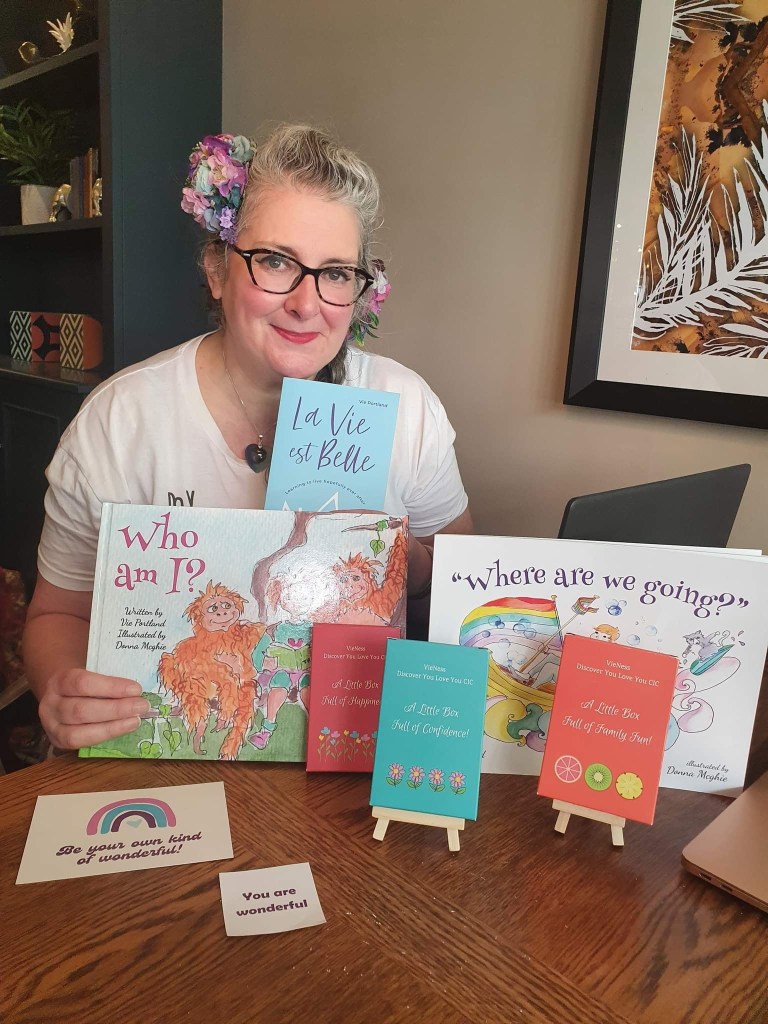
My children’s books are inclusive children’s picture books, where Emily, the main character, goes on lots of wonderful imaginary adventures. So far, two Emily books have been published, “Where Are We Going?” and “Who Am I?”; I have more Emily stories written and other books for children, and the general theme is inclusion, acceptance, and feeling good about ourselves, which ties in with my work in my Community Interest Company, where I teach self-esteem and confidence to children, young people, and women, in schools, groups, libraries, organisations, and one to one.
I’ve also published “La Vie Est Belle”, which is partly my story of going from hating who I was and how I looked, and why, to showing how I taught myself to celebrate everything I am.
I recently compiled a book of stories from the EB community, “Extraordinary Butterflies”, where people that live with the rare disability Epidermolysis Bullosa could share their stories of living with the condition, including myself. Everyone involved with the book lives with EB in one way or another, and our cover was designed by two girls, aged 10 and 11. Several children have contributed pieces, as well as parents, partners, and those of us that have the disability.
How did they come about?
I had two lines in my head for years, which feature in “Where Are We Going?” I’ve worked with children most of my life, in one form or another, so I have spent a lot of time at bus stops and train stations, because buses and trains are exciting. I have heard so many children ask their adults where they were going, or wanting to have a conversation about the bus or train we are waiting for, only to be told to be quiet, or “I’ve already told you!” This isn’t at all about moaning about parents/carers, because most do a wonderful job, however, we’re taught to be imaginative in primary schools, then told to grow up and not be silly in high schools, so lots of people lose their confidence in being imaginative, so can’t think of fun answers quickly. I wanted to show that, in much the same time as it takes to say, “I’ve already told you where we are going!”, you can say that you’re going off to sail a rainbow sea in a boat full of bubbles. Children understand imagination and they know that we can visit so many places in our minds.
Then, just before the pandemic, a lovely friend, Dr. Jennifer Jones, said I should write a book to establish my expertise in my field. I started on “La Vie” and, because I was letting that creativity flow out of me, those two lines came to mind and I started writing the children’s books, too.
What do your readers’ learn from your books?
I hope that my messages come across in a fun, caring way. I believe passionately in inclusion, in making the world a kinder, happier, more accepting, place, and that comes across in all of my books.
It’s only around 4% of books that feature a main character with a disability, and the majority of those are raising awareness of the disability, which is important. There are other things to consider, though. The majority of the representations of disability are people in wheelchairs yet, in reality, only 8% of the disabled community use wheelchairs; more of us use other aides or none at all, yet people are being shown that the wheelchair is the only accepted form of disability. The other thing to consider is that studies have shown that most children will not make friends with someone who is different to them, whether that is size, shape, colour, disability, or disfigurement, so, as wonderful as awareness raising books are, they are also pointing out our differences. With disability hate crimes rising, these are things that need to be considered. In my Emily books, Emily has a visible difference but it’s not part of the story; the first time her difference is mentioned is in the discussion questions at the end of the book. I want readers to see that we all have far more in common than that which makes us different, and seeing Emily have lots of wonderful adventures will help with that.
In my books for adults, I share about the importance of inclusion and acceptance, too. I believe that, by being kinder to, and more accepting of, ourselves, we’ll be kinder to, and more accepting, of others.
To find more about Vie and her books, click the links below:
My website is; https://www.vieness.co.uk
Facebook: https://www.facebook.com/VieNessCIC
Instagram: https://www.instagram.com/VieNessCIC
LinkedIn: https://www.linkedin.com/in/VieNessCIC
 More to Books